Welcome to Pride Month 2026 where we reflect with a series of blogs on Plymouth’s queer history.
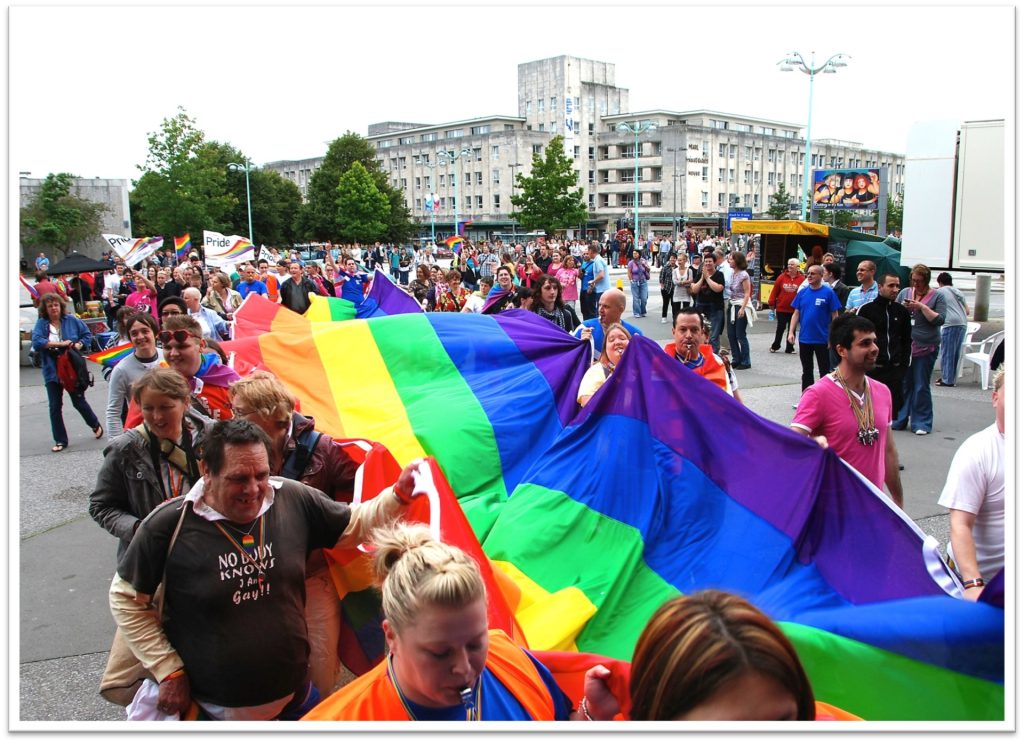
We begin on Saturday 22nd August 2009, as people gathered at the Plymouth City Centre Piazza to surround a rainbow flag over fifty metres long. The flag had been laid there for just over an hour to serve as, what the local newspaper had referred to as, “a symbol of Gay Pride.”
In Plymouth, weekend shoppers and other passers-by looked on as marshals blew whistles and directed the milling crowd around the flag. At 11.30am, it was lifted by the assembled crowd and carried towards the City Guildhall. The procession was led by veteran human rights activist Peter Tatchell. This was his first visit to the city, made at the request of Plymouth Pride Event, which had organized the event. It was, at the time, the most public display of gay identity to have ever occurred in the city of Plymouth.
Local newspaper coverage explained that the purpose of this event was for the LGBTQ+ community of Plymouth to mark the occasion of the forty-year anniversary of the “birth of the modern gay rights movement,” which was described as taking place at the Stonewall Inn in New York’s Greenwich Village four decades previously. The chair of the Plymouth Pride Event recalled in an interview three years later, that the intention had never been for this event to be specifically regarded as a public parade: “What we wanted to do was leave the flag laid out so people going past would actually say ‘What’s this flag about?’” He said it created “quite a bit of interest” and some controversy, when a local religious group objected to such a public display of a symbol of homosexuality.
At that time, Peter Tatchell went on record to say how important the event was for the city and very publicly criticised the Royal Navy for its lack of participation. “The Royal Navy is guilty of rank hypocrisy,” were his words at the time. “It sent fifty sailors to march in the London Pride gay parade in July but has failed to support the gay festival in its home town of Plymouth”. The Navy were quick to respond that it was a staffing issue that caused their lack of attendance rather than any more deep-seated sense of inappropriateness although Tatchell still regarded this as an oversight on their part in light of the city’s close-knit association with the Navy. He told the local media that “Plymouth has a long, historic tradition and is one of the main ports of the Royal Navy. It’s not the most tolerant city in Britain. Parts of the city are quite rough and homophobic. Given the sometimes less enlightened local attitudes, it’s much more important that the navy has a presence at Plymouth Pride than at London Pride”.
This procession provided a momentary public display of gay identity by Plymouth’s LGBTQ+ communities, negotiated and performed in a city in which the Navy plays a significant role. It lasted for only minutes before being obscured from view again within the institution of the city’s Civic Centre. Plymouth’s attempt at a Pride parade in 2009 was both a result, and a public representation, of a unique history pertaining to several groups of people living in the city over the previous sixty years which had remained mostly undiscussed and underrepresented. Until the Pride in our Past project came into being a few years later . . .